12-Month Financial Forecast Workbook
$79.00
Build a baseline for the next year and compare how changes in revenue, costs, or collection timing affect the monthly outlook. Use scenario planning to document assumptions before choosing how to allocate spending or capacity.
Description
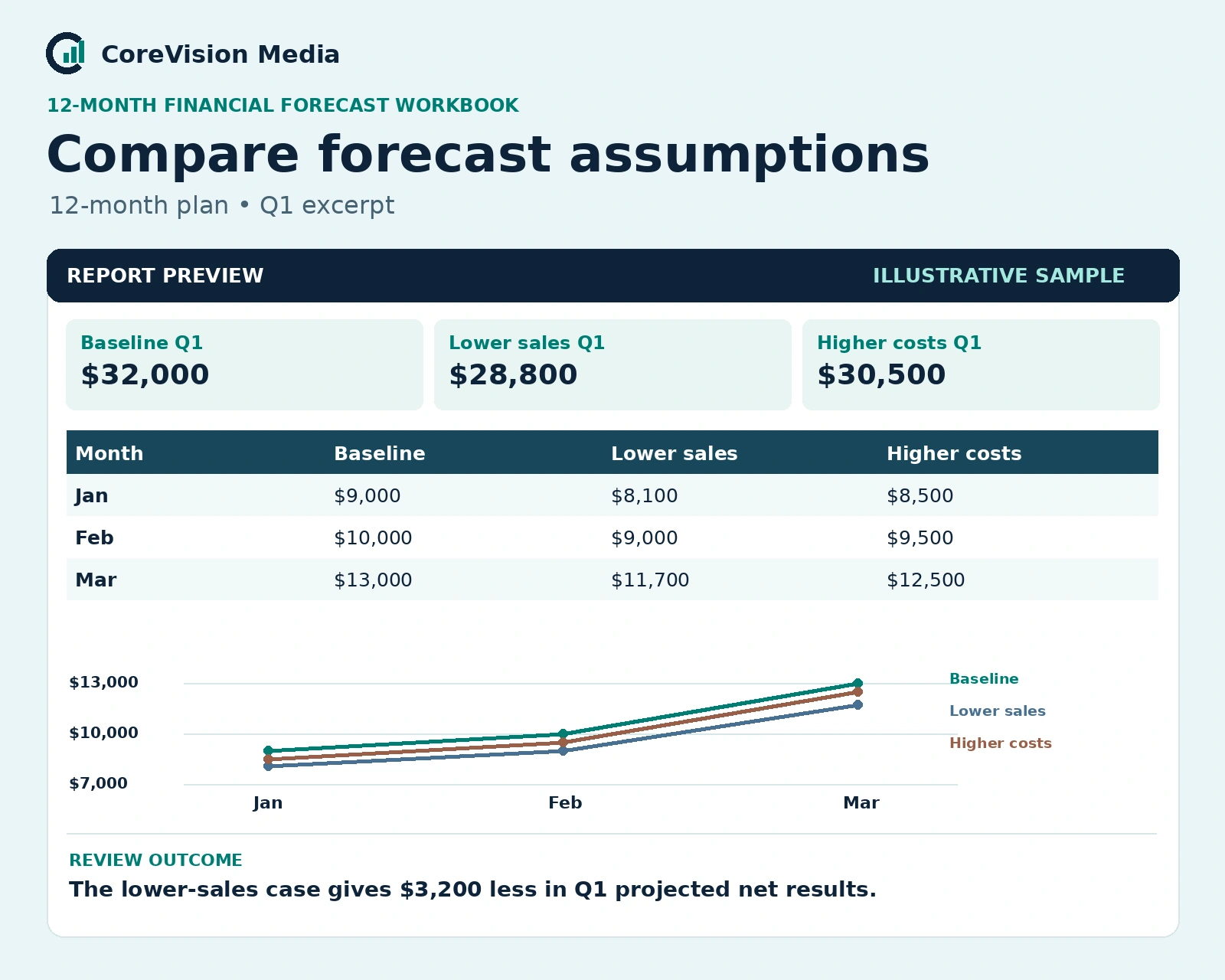
Build a 12-month financial forecast in Excel
Use the 12-Month Financial Forecast Workbook to compare the year you currently expect with the year you might face if sales soften, supplier costs rise, or customers pay later. Set a baseline using your current estimates, then change one assumption at a time. Review monthly profit and closing cash separately to see which decision matters first.
What the forecast helps you evaluate
- Revenue. Record expected sales volume and prices. Review how a change in either affects revenue and projected profit.
- Operating costs. Enter supplier costs, payroll, rent, and one-time commitments. Check which months will absorb the increase.
- Payment timing. Enter opening cash and expected collection and payment dates. See when funds may run low.
How to compare financial scenarios
- Build a dated baseline. Enter your best current estimates for the 12-month period. Record the basis for major figures, such as a supplier quote, a signed order, or a collection estimate.
- Test one change at a time. Keep the reporting period and unaffected inputs consistent. Compare a sales, cost, or collection change against the baseline before combining changes.
- Review the first affected month. Compare projected profit and closing cash in that month. Check if the change lasts for one period or continues through the rest of the year.
- Update the outlook as actual results arrive. Record what changed and why before revising the assumptions you use for the next review.
Worked example
Rising supplier costs and a delayed customer payment
A business starts April with $12,000 in cash, expects $40,000 in receipts, and schedules $38,000 in payments. The scheduled payments include $15,000 in supplier costs. In the cost scenario, the supplier raises prices by 8% and the extra $1,200 is paid in April. In the collection scenario, a $10,000 customer receipt moves from April to May.
April closing cash by scenario
- Baseline — $14,000. $12,000 opening cash, plus $40,000 collected, less $38,000 paid.
- Higher supplier costs — $12,800. Cash payments increase by $1,200.
- Delayed customer receipt — $4,000. April collections fall to $30,000.
- Both changes — $2,800. April collections fall to $30,000 and payments increase to $39,200.
If the extra supplier cost is recognized in April, projected April profit falls by $1,200, assuming everything else stays the same. The delayed receipt reduces April cash by $10,000 without changing April profit if the sale was already recorded. If both changes occur, the business has $2,800 at month-end. That gives the owner a figure to compare with the cash needed before May receipts arrive.
Which workbook should I choose?
Choose 12-Month Financial Forecast when you need to compare operating assumptions before setting a sales target, changing prices, or committing to higher costs. Choose the Monthly Cash Flow Workbook when you need to check whether money will arrive in time to pay the bills due in a specific month.
Frequently asked questions
Can I compare several changes together?
Yes. Test each change separately first so you can see its effect. Then combine the assumptions that could occur together and review the impact on each month.
What should I revisit as actual results come in?
Check the estimates that drove the largest differences. Review sales volume, prices, major costs, and collection dates before carrying the same assumptions into the next forecast.
For questions about workbook specifications or compatibility, contact CoreVision Media.
Reviews
There are no reviews yet.